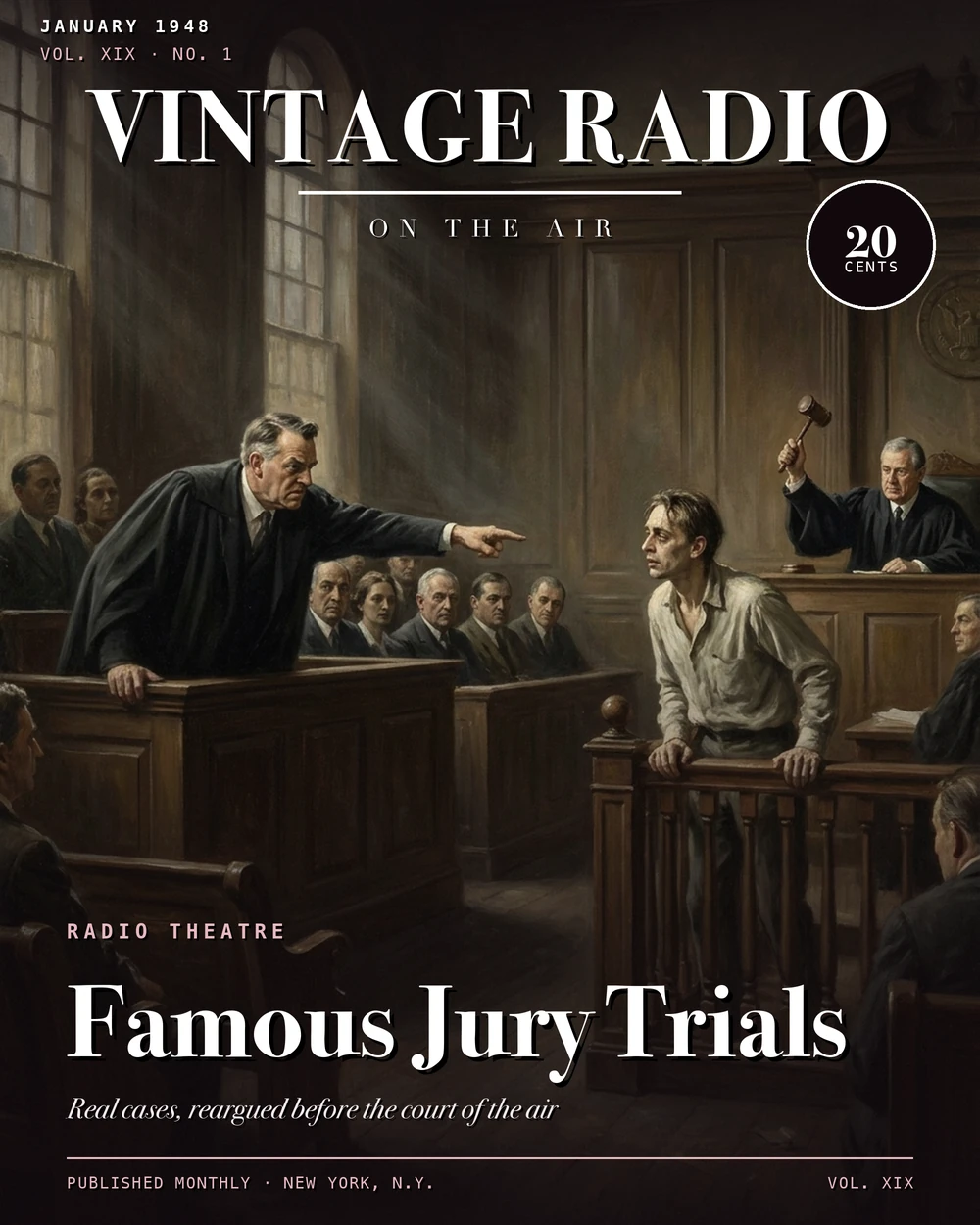
Famous Jury Trials
The Show That Took You Inside the Courtroom
Long before television discovered the courtroom as a dramatic setting, Famous Jury Trials was doing something genuinely unusual on radio. Starting January 5, 1936, on the Mutual network, the show dropped listeners directly into an active trial — no musical score, no narrator setting the mood, just the hollow ambient noise of a large courthouse and voices delivering testimony. That deliberate stripping away of conventional radio atmosphere was the whole point. The producers wanted it to feel like you'd wandered into the spectator gallery and sat down. It's now recognized as one of the first programs to establish the court-drama genre on radio — a template the show would later carry into television as well.
The show's pitch was direct and plainspoken: "the dramatic story of our courts, where rich and poor alike, guilty and innocent, stand before the bar of justice." Each episode opened the same way, with actor Maurice Franklin — playing the judge — delivering a charge to the jury: "Be just and fear not, for the true administration of justice is the foundation of good government." Then the trial began, and it was mostly on you to follow along.
The stories were drawn from actual case histories, though heavily fictionalized in the telling. Radio Mirror observed at the time that the fictionalization was "not enough to fool you" if the case was recent and well-known. That tension between real event and dramatized reconstruction was part of what kept listeners engaged — the sense that something like this had actually happened, even if the names and details had been changed.
Origins at WLW
Famous Jury Trials began life at WLW in Cincinnati, the brainchild of staff writer and producer Edward Armour Byron — born October 20, 1905, in Newport, Kentucky, and known professionally as Ed Byron. He had already created Moon River at WLW at the personal request of station owner Powel Crosley, Jr., and he went freelance in 1935, the year before Famous Jury Trials premiered. Byron turned out to be a serial innovator: he went on to create Mr. District Attorney, one of radio's biggest crime hits, and was still inventing new formats decades later, leaving NBC in 1964 to develop Theatre Five at ABC. He died in New Haven on November 21, 1964, having spent nearly thirty years pioneering dramatic forms across two media.
By 1937 the show was being carried by WOR in New York, WGN in Chicago, WFIL in Philadelphia, and KWK in St. Louis — identified in trade listings as "stations of the WLW line." Production shifted from Cincinnati to New York City by 1938. A 1942 newspaper account described the physical set: a courtroom with a jury box for twelve, a judge in a black robe on a high bench, witness chair to his left, clerk at a desk in front. The same article noted that attorney and law historian Martin H. Young checked the legal fireworks "for scriptural realism."
No Music, No Mercy
The absence of a musical score wasn't an oversight — it was the show's defining production choice. Most radio drama of the era used music to cue emotion, to bridge scenes, to signal transitions. Famous Jury Trials used none of that. Testimony stood on its own, and the production leaned hard on crowd noise and courtroom ambience to fill the space where music would normally go. The hollow acoustic of a big old courthouse became the show's signature sound.
This approach forced the writing to carry more weight. In later episodes, the format evolved so that scenes were developed entirely through dialogue, with a reporter-narrator stepping in only to bridge the gaps between testimony. Roger DeKoven, DeWitt McBride, and others rotated through the reporter-narrator role over the years, and their cut-ins were kept lean — just enough to connect the most dramatic moments of a case. The rest was left to the witnesses, the lawyers, and the crowd reacting in the background.
Testimony was also carefully edited. Writers didn't try to dramatize an entire trial; they identified the most explosive exchanges and built the episode around those, letting the reporter carry everything else in summary. Don Becker handled the producer-writer role in the early 1936 period, with Milton J. Kramer, Jerry McGill, and Stedman Coles contributing to the writing over the show's long run. Clark Andrews and Carl Eastman directed. Don Foster managed sound effects during the Mutual broadcasts, where the lack of music made his work all the more prominent.
A Technique That Showed Up Elsewhere
One of the more inventive things Famous Jury Trials developed was the idea of sending a radio announcer back in time to report on historical trials as if they were happening live. The announcer would appear inside an old case — decades or centuries prior — and narrate events as a contemporary eyewitness. The show used the device to dramatize trials of Captain Kidd, Benedict Arnold, and Aaron Burr, among others. It was a clever workaround for the fundamental problem of dramatizing history: instead of asking the audience to accept a period reconstruction, the show grafted a modern voice onto the past.
This technique appeared on Famous Jury Trials a good fifteen years before You Are There adopted it as its central format in the early 1950s. You Are There became famous for sending CBS reporters into historical events, but the approach had already been road-tested in the courtroom drama format that Famous Jury Trials had been running since the late 1930s.
Supporting cast for these reconstructions and the contemporary cases alike drew from New York radio personnel, including Raymond Edward Johnson — later the host of Inner Sanctum Mysteries — Frank Readick, an early voice of The Shadow and a Mercury Theatre regular, and Mandel Kramer, who had studied law before going into acting and would later play Johnny Dollar on CBS and Chief Bill Marceau on television's The Edge of Night. They were experienced documentary-style voices who could handle the format without the kind of theatrical projection that might have undercut the show's realism.
A Long Run Across Three Homes
The show's broadcast history was anything but simple. Its first Mutual run, from January 5, 1936, to December 20, 1937, used an unusual 45-minute timeslot — longer than most drama programs of the period. Mermen sponsored that initial run. The show came back to Mutual for a shorter second stint from November 2, 1938, to March 8, 1939, this time in a standard 30-minute Wednesday night slot with Goodrich as sponsor.
The longest chapter of the show's history began November 11, 1940, when it moved to the Blue Network, which later became ABC. That run lasted until June 25, 1949 — nearly nine years. The timeslots shifted around considerably: Tuesdays at 9 from 1941 to 1944, Fridays at 8:30 or 9 from 1944 to 1946, and Saturdays at 8:30 from 1946 to 1949. Oh Henry Candy sponsored from 1940 to 1946, with General Mills picking up the sponsorship from 1947 to 1948. The show outlasted multiple sponsors and multiple scheduling changes, which suggests it was holding an audience through all of it.
How the Verdicts Landed
Part of what kept listeners coming back, apparently, was the endings. The verdict came at the close of each episode, and the show had a reputation for surprising its audience. In cases drawn from recent headlines, a careful listener might know what the real outcome had been — but the fictionalization left enough uncertainty that the verdict could still land as a genuine surprise. In older historical cases, the outcome might be genuinely unknown to most of the audience, which made the jury's decision feel like live drama.
That final moment — the verdict — was the payoff for an entire episode of testimony and procedural maneuvering. By withholding it until the end and building through accumulated courtroom detail rather than musical crescendo, the show turned the jury's decision into the dramatic climax. It was a simple structural choice, but it worked consistently enough over thirteen years to keep the format viable well into the late 1940s.
Afterlife on Television
The radio show ended in June 1949, but Famous Jury Trials moved almost immediately to the DuMont Television Network, where it premiered October 12, 1949 — though the first episode, "The People vs. Frank Johnson," had actually gone out a week earlier on October 5, written by John L. Clark and directed by Frank Bunetta. That opening cast included Fredd Wayne, James Van Dyke, Watson White, Charlotte Keane, Jim Boles, Roy Fant, Frank Tweddell, and Delmar Nuetzman. The series aired live from WABD using four sets at the Adelphi Theater, with Chevrolet Dealers as the sponsor; it was also picked up by KTSL in California and WGN-TV in Chicago. The first season ran Wednesdays at 9:30 pm EST, later moving up to 9:00. Because the show was live, actors playing litigants had to dash between the courtroom set and a separate flashback set, then race back to the witness stand. Recurring performers included Joyce Randolph, who would soon become famous as Trixie Norton on The Honeymooners. The DuMont run ended March 12, 1952.
Two decades later, a Canadian production revived the title once more: a 1971 CTV series, also called Famous Jury Trials, filmed at the network's Agincourt studio in Toronto and dramatizing notable Canadian and American cases. Its regular cast included Jayne Eastwood, Tim Henry, Cec Linder, and Joanna Noyes, and a Toronto Star item noted that Vivian Vance — Ethel Mertz of I Love Lucy — had turned up for an appearance while The Trouble With Tracey was shooting on the same lot.
Add the radio years, the DuMont run, and the Canadian revival together and the Famous Jury Trials franchise covered roughly 35 years across three media — a long second life for a show that started as one writer's idea in a Cincinnati studio. No episodes of the radio version are confirmed to survive, though one may exist at the Paley Center for Media. It wasn't a flashy show. It was patient, procedural, and willing to trust the material — and that turned out to be a template durable enough to outlast its own first medium twice over.